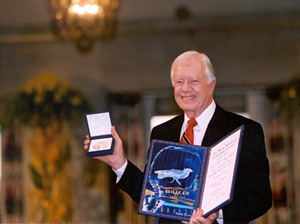
| President
Carter's Nobel Lecture
By Jimmy Carter -- December 10,2002
Your Majesties, Members of the Norwegian
Nobel Committee, Excellencies, Ladies
and Gentlemen:
It is with a deep sense of gratitude
that I accept this prize. I am grateful
to my wife Rosalynn, to my colleagues
at The Carter Center, and to many
others who continue to seek an end
to violence and suffering throughout
the world. The scope and character
of our Center's activities are perhaps
unique, but in many other ways they
are typical of the work being done
by many hundreds of nongovernmental
organizations that strive for human
rights and peace.
Most Nobel laureates have carried
out our work in safety, but there
are others who have acted with great
personal courage. None has provided
more vivid reminders of the dangers
of peacemaking than two of my friends,
Anwar Sadat and Yitzhak Rabin, who
gave their lives for the cause of
peace in the Middle East.
Like these two heroes, my first chosen
career was in the military, as a submarine
officer. My shipmates and I realized
that we had to be ready to fight if
combat was forced upon us, and we
were prepared to give our lives to
defend our nation and its principles.
At the same time, we always prayed
fervently that our readiness would
ensure that there would be no war.
Later, as President and as Commander-in-Chief
of our armed forces, I was one of
those who bore the sobering responsibility
of maintaining global stability during
the height of the Cold War, as the
world's two superpowers confronted
each other. Both sides understood
that an unresolved political altercation
or a serious misjudgment could lead
to a nuclear holocaust. In Washington
and in Moscow, we knew that we would
have less than a half hour to respond
after we learned that intercontinental
missiles had been launched against
us. There had to be a constant and
delicate balancing of our great military
strength with aggressive diplomacy,
always seeking to build friendships
with other nations, large and small,
that shared a common cause.
In those days, the nuclear and conventional
armaments of the United States and
the Soviet Union were almost equal,
but democracy ultimately prevailed
because of commitments to freedom
and human rights, not only by people
in my country and those of our allies,
but in the former Soviet empire as
well. As president, I extended my
public support and encouragement to
Andrei Sakharov, who, although denied
the right to attend the ceremony,
was honored here for his personal
commitments to these same ideals.
The world has changed greatly since
I left the White House. Now there
is only one superpower, with unprecedented
military and economic strength. The
coming budget for American armaments
will be greater than those of the
next fifteen nations combined, and
there are troops from the United States
in many countries throughout the world.
Our gross national economy exceeds
that of the three countries that follow
us, and our nation's voice most often
prevails as decisions are made concerning
trade, humanitarian assistance, and
the allocation of global wealth. This
dominant status is unlikely to change
in our lifetimes.
Great American power and responsibility
are not unprecedented, and have been
used with restraint and great benefit
in the past. We have not assumed that
super strength guarantees super wisdom,
and we have consistently reached out
to the international community to
ensure that our own power and influence
are tempered by the best common judgment.
Within our country, ultimate decisions
are made through democratic means,
which tend to moderate radical or
ill-advised proposals. Constrained
and inspired by historic constitutional
principles, our nation has endeavored
for more than two hundred years to
follow the now almost universal ideals
of freedom, human rights, and justice
for all.
Our president, Woodrow Wilson, was
honored here for promoting the League
of Nations, whose two basic concepts
were profoundly important: "collective
security" and "self-determination."
Now they are embedded in international
law. Violations of these premises
during the last half-century have
been tragic failures, as was vividly
demonstrated when the Soviet Union
attempted to conquer Afghanistan and
when Iraq invaded Kuwait.
After the second world war, American
Secretary of State Cordell Hull received
this prize for his role in founding
the United Nations. His successor,
General George C. Marshall, was recognized
because of his efforts to help rebuild
Europe, without excluding the vanquished
nations of Italy and Germany. This
was a historic example of respecting
human rights at the international
level.
Ladies and gentlemen:
Twelve years ago, President Mikhail
Gorbachev received your recognition
for his preeminent role in ending
the Cold War that had lasted fifty
years.
But instead of entering a millennium
of peace, the world is now, in many
ways, a more dangerous place. The
greater ease of travel and communication
has not been matched by equal understanding
and mutual respect. There is a plethora
of civil wars, unrestrained by rules
of the Geneva Convention, within which
an overwhelming portion of the casualties
are unarmed civilians who have no
ability to defend themselves. And
recent appalling acts of terrorism
have reminded us that no nations,
even superpowers, are invulnerable.
It is clear that global challenges
must be met with an emphasis on peace,
in harmony with others, with strong
alliances and international consensus.
Imperfect as it may be, there is no
doubt that this can best be done through
the United Nations, which Ralph Bunche
described here in this same forum
as exhibiting a "fortunate flexibility"
- not merely to preserve peace but
also to make change, even radical
change, without violence.
He went on to say: "To suggest
that war can prevent war is a base
play on words and a despicable form
of warmongering. The objective of
any who sincerely believe in peace
clearly must be to exhaust every honorable
recourse in the effort to save the
peace. The world has had ample evidence
that war begets only conditions that
beget further war."
We must remember that today there
are at least eight nuclear powers
on earth, and three of them are threatening
to their neighbors in areas of great
international tension. For powerful
countries to adopt a principle of
preventive war may well set an example
that can have catastrophic consequences.
If we accept the premise that the
United Nations is the best avenue
for the maintenance of peace, then
the carefully considered decisions
of the United Nations Security Council
must be enforced. All too often, the
alternative has proven to be uncontrollable
violence and expanding spheres of
hostility.
For more than half a century, following
the founding of the State of Israel
in 1948, the Middle East conflict
has been a source of worldwide tension.
At Camp David in 1978 and in Oslo
in 1993, Israelis, Egyptians, and
Palestinians have endorsed the only
reasonable prescription for peace:
United Nations Resolution 242. It
condemns the acquisition of territory
by force, calls for withdrawal of
Israel from the occupied territories,
and provides for Israelis to live
securely and in harmony with their
neighbors. There is no other mandate
whose implementation could more profoundly
improve international relationships.
Perhaps of more immediate concern
is the necessity for Iraq to comply
fully with the unanimous decision
of the Security Council that it eliminate
all weapons of mass destruction and
permit unimpeded access by inspectors
to confirm that this commitment has
been honored. The world insists that
this be done.
I thought often during my years in
the White House of an admonition that
we received in our small school in
Plains, Georgia, from a beloved teacher,
Miss Julia Coleman. She often said:
"We must adjust to changing times
and still hold to unchanging principles."
When I was a young boy, this same
teacher also introduced me to Leo
Tolstoy's novel, "War and Peace."
She interpreted that powerful narrative
as a reminder that the simple human
attributes of goodness and truth can
overcome great power. She also taught
us that an individual is not swept
along on a tide of inevitability but
can influence even the greatest human
events.
These premises have been proven by
the lives of many heroes, some of
whose names were little known outside
their own regions until they became
Nobel laureates: Albert John Lutuli,
Norman Borlaug, Desmond Tutu, Elie
Wiesel, Aung San Suu Kyi, Jody Williams,
and even Albert Schweitzer and Mother
Teresa. All of these and others have
proven that even without government
power - and often in opposition to
it - individuals can enhance human
rights and wage peace, actively and
effectively.
The Nobel prize also profoundly magnified
the inspiring global influence of
Martin Luther King, Jr., the greatest
leader that my native state has ever
produced. On a personal note, it is
unlikely that my political career
beyond Georgia would have been possible
without the changes brought about
by the civil rights movement in the
American south and throughout our
nation.
On the steps of our memorial to Abraham
Lincoln, Dr. King said: "I have
a dream that on the red hills of Georgia
the sons of former slaves and the
sons of former slaveowners will be
able to sit down together at a table
of brotherhood."
The scourge of racism has not been
vanquished, either in the red hills
of our state or around the world.
And yet we see ever more frequent
manifestations of his dream of racial
healing. In a symbolic but very genuine
way, at least involving two Georgians,
it is coming true in Oslo today.
I am not here as a public official,
but as a citizen of a troubled world
who finds hope in a growing consensus
that the generally accepted goals
of society are peace, freedom, human
rights, environmental quality, the
alleviation of suffering, and the
rule of law.
During the past decades, the international
community, usually under the auspices
of the United Nations, has struggled
to negotiate global standards that
can help us achieve these essential
goals. They include: the abolition
of land mines and chemical weapons;
an end to the testing, proliferation,
and further deployment of nuclear
warheads; constraints on global warming;
prohibition of the death penalty,
at least for children; and an international
criminal court to deter and to punish
war crimes and genocide. Those agreements
already adopted must be fully implemented,
and others should be pursued aggressively.
We must also strive to correct the
injustice of economic sanctions that
seek to penalize abusive leaders but
all too often inflict punishment on
those who are already suffering from
the abuse.
The unchanging principles of life
predate modern times. I worship Jesus
Christ, whom we Christians consider
to be the Prince of Peace. As a Jew,
he taught us to cross religious boundaries,
in service and in love. He repeatedly
reached out and embraced Roman conquerors,
other Gentiles, and even the more
despised Samaritans.
Despite theological differences,
all great religions share common commitments
that define our ideal secular relationships.
I am convinced that Christians, Muslims,
Buddhists, Hindus, Jews, and others
can embrace each other in a common
effort to alleviate human suffering
and to espouse peace.
But the present era is a challenging
and disturbing time for those whose
lives are shaped by religious faith
based on kindness toward each other.
We have been reminded that cruel and
inhuman acts can be derived from distorted
theological beliefs, as suicide bombers
take the lives of innocent human beings,
draped falsely in the cloak of God's
will. With horrible brutality, neighbors
have massacred neighbors in Europe,
Asia, and Africa.
In order for us human beings to commit
ourselves personally to the inhumanity
of war, we find it necessary first
to dehumanize our opponents, which
is in itself a violation of the beliefs
of all religions. Once we characterize
our adversaries as beyond the scope
of God's mercy and grace, their lives
lose all value. We deny personal responsibility
when we plant landmines and, days
or years later, a stranger to us -
often a child - is crippled or killed.
From a great distance, we launch bombs
or missiles with almost total impunity,
and never want to know the number
or identity of the victims.
At the beginning of this new millennium
I was asked to discuss, here in Oslo,
the greatest challenge that the world
faces. Among all the possible choices,
I decided that the most serious and
universal problem is the growing chasm
between the richest and poorest people
on earth. Citizens of the ten wealthiest
countries are now seventy-five times
richer than those who live in the
ten poorest ones, and the separation
is increasing every year, not only
between nations but also within them.
The results of this disparity are
root causes of most of the world's
unresolved problems, including starvation,
illiteracy, environmental degradation,
violent conflict, and unnecessary
illnesses that range from Guinea worm
to HIV/AIDS.
Most work of The Carter Center is
in remote villages in the poorest
nations of Africa, and there I have
witnessed the capacity of destitute
people to persevere under heartbreaking
conditions. I have come to admire
their judgment and wisdom, their courage
and faith, and their awesome accomplishments
when given a chance to use their innate
abilities.
But tragically, in the industrialized
world there is a terrible absence
of understanding or concern about
those who are enduring lives of despair
and hopelessness. We have not yet
made the commitment to share with
others an appreciable part of our
excessive wealth. This is a potentially
rewarding burden that we should all
be willing to assume.
Ladies and gentlemen:
War may sometimes be a necessary
evil. But no matter how necessary,
it is always an evil, never a good.
We will not learn how to live together
in peace by killing each other's children.
The bond of our common humanity is
stronger than the divisiveness of
our fears and prejudices. God gives
us the capacity for choice. We can
choose to alleviate suffering. We
can choose to work together for peace.
We can make these changes - and we
must.
Thank you.
© THE NOBEL FOUNDATION 2002
|